Many entrepreneurs and freelancers in Riyadh, Jeddah, and Dammam are searching for a practical alternative to the traditional paper business card, and this is where the term digital business card emerges as a solution that combines ease of sharing with professional presentation. The digital card is not just a trend, but a marketing tool that helps you leave a professional impression at first contact, whether in a business meeting, a trade show, or even over WhatsApp. With the growing reliance on digital channels in the Saudi business environment, many managers and small business owners are seriously considering abandoning printed paper in favor of a more flexible, up-to-date solution. In this guide, we explain everything you need to know before choosing or designing your digital card in 2026, with practical examples from the Saudi market, comparison tables, and clear steps to help you make the right decision without confusion or wasted time.
What is a digital business card and why has it become a necessity?
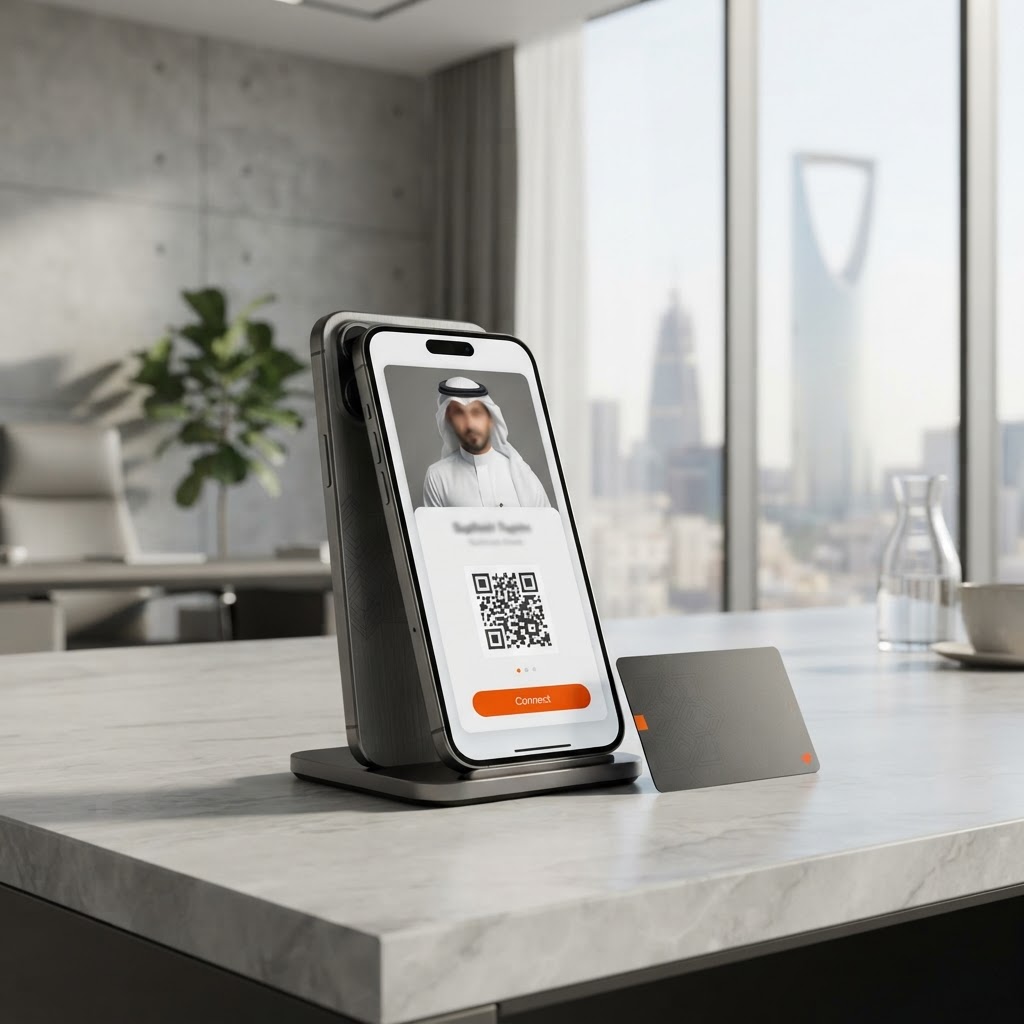
A digital business card is an electronic version of your traditional ID card, containing your name, job title, contact details, and links to your professional accounts. It can be shared via a link, QR code, or even NFC technology, without needing to print new cards every time your information changes.
The importance of the digital business card lies in the fact that it reflects a modern image of the company or individual, especially in a Saudi business environment that is moving strongly toward digital transformation across nearly every sector, from real estate to consulting to e-commerce. For example, a small consulting office in Riyadh may need to introduce itself to new clients in back-to-back meetings on the same day, and here, sharing a card with the push of a button becomes far faster than searching for a paper card in a pocket or wallet.
It also allows the business owner to update information at any time without reprinting, saving time and effort compared to the traditional method, especially for those who frequently change their mobile number or job title. Imagine a sales employee who recently moved to a new real estate company in Jeddah; instead of printing hundreds of new cards, it's enough to update their information on the digital card within minutes to start working immediately without interruption.
From a marketing perspective, the digital card also offers the opportunity to add richer content than just a name and phone number, such as a website link, a short introductory video, or even a direct appointment booking button — something that's difficult to achieve with the same efficiency on a piece of paper, no matter how well designed.
The difference between paper and smart digital business cards
Before deciding to make the switch, it's helpful to compare the two options directly to understand where the real benefit lies for you and your business.
| Element | Paper Card | Digital Business Card |
|---|---|---|
| Cost of updating | New printing each time | Instant editing at no extra cost |
| Ease of sharing | Manual handover only | Link, QR, or NFC remotely |
| Risk of loss | Likely and easy | Always saved digitally |
| Containing links and media | Very limited | Supports links, video, and website |
| First impression | Traditional | Professional and modern |
| Environmental sustainability | Continuous paper consumption | No paper, no repeated printing |
This comparison explains why many startups and consulting offices in Saudi Arabia are adopting the digital card as part of their visual identity, especially when requesting a complete brand identity design that covers every element of brand presentation, starting from the logo and ending with the business card.
Features of the smart business card that matter to you as a business owner
The smart business card outperforms its paper counterpart in several practical aspects that directly touch the needs of business owners in the Saudi market, most notably:
- Instant sharing via WhatsApp or text message without both parties needing to be face to face, which is very useful when following up after a phone call or remote meeting.
- The ability to link it to social media accounts, websites, and mobile numbers directly, making it a single point of access for all communication channels instead of scattering them across multiple platforms.
- Updating information at any time without reprinting or replacing previously distributed old copies, which is very important for companies that are expanding or frequently changing branches.
- Greater compatibility with the nature of modern meetings and exhibitions that rely on QR codes as a quick means of exchanging information.
- A professional impression that builds trust, especially with clients who expect a digital presence from any serious company in its field.
- The ability to measure a type of engagement with the card, such as the number of times it's opened or its links are clicked, giving the business owner insight into how interested the recipient is.
These features make the digital card a logical choice for small and medium business owners, as well as for independent consultants and marketers who need a quick and flexible way to introduce themselves at every business occasion, whether at a conference in Dammam or a casual business meeting at a café in Riyadh.
Steps to turn your business card into a digital one
The process of converting your business card into a digital one isn't complicated if planned properly, and it typically goes through the following steps:
- Determine the essential information you want to display: name, job title, mobile number, email, and office location if applicable.
- Choose the important links you want to add, such as LinkedIn, your website, your business WhatsApp, or even a consultation booking page.
- Adopt a visual identity consistent with your brand's colors and logo, so the card doesn't appear as a separate element from the rest of your marketing materials.
- Choose the appropriate sharing method: a direct link sent via WhatsApp, a QR code printed on a small physical card, or an NFC card that just needs to be tapped against a phone.
- Test the card on different devices — iPhone and Android — and on networks with varying speeds before officially using it with clients.
- Train your sales team or relevant employees on how to share the card quickly in any situation, whether inside the office or at an external exhibition.
Many business owners prefer to work with a specialized provider to ensure the card is fully compatible with their complete visual identity, just as they ensure consistency in digital content design across their other marketing platforms. After all, the card is ultimately an extension of the company's image, not an isolated element from it.
Foundations of professional digital business card design
Successful digital business card design isn't just about placing information; it requires clear marketing thinking that serves the business owner's goal, and it usually rests on several key pillars.
Simplicity and clarity first
The card should be free of visual clutter, with a logical arrangement of information starting with the name, then the job title, then contact methods, so that whoever opens the card can understand your identity within a few seconds without needing to scroll much.
Consistency with visual identity
Colors and fonts should reflect the identity of the company or individual, making the card part of an integrated marketing system rather than a separate element, just like any other marketing material issued under the brand's name.
Easy access from any device
A good card works smoothly on mobile and desktop without display issues, which sometimes requires linking it to a page designed within a professional website that supports this type of content and ensures it displays properly across different screen sizes.
Clear call to action
It's helpful for the card to include a clear button to save the contact directly, or a button to reach out via WhatsApp, turning the first impression into an actual step toward communication rather than just a passing glance.
Paying attention to these foundations turns the card into a genuine marketing tool rather than just a cold profile that's opened once and forgotten.
Where is the digital card used in the Saudi market?
The uses of the digital business card are numerous in the Saudi business environment, suiting the nature of different sectors in a way that makes it a flexible choice for most commercial activities.
- Trade shows and conferences in Riyadh and Jeddah, where scanning a QR code is much easier than carrying stacks of paper cards, especially at events that run for several days and host a large number of visitors.
- Consulting offices and professional services firms that need to quickly introduce their team to new clients, whether in law firms or financial consulting offices.
- Field sales teams in real estate and retail companies who move frequently between clients and need a quick way to introduce themselves at every field visit.
- Freelancers and small business owners who manage their personal brand across multiple channels and need a unified, easily shareable point of contact.
- The healthcare sector and private clinics that want to professionally present their medical team to patients and referring parties.
In many of these cases, the digital card works in full integration with social media management efforts, becoming a single collection point for all communication links instead of scattering them, making it easier for clients to follow your activity from one place.
Integrating the digital card into your overall marketing strategy
The digital business card isn't a tool separate from the rest of your marketing efforts, but part of a larger system that includes your website, content, and advertising campaigns. For example, a startup in Dammam preparing to launch a paid advertising campaign could benefit from adding its digital card link to its email signature or contact page, ensuring that everyone who engages with the campaign finds an easy, quick way to reach the sales team directly.
Likewise, when participating in an event or trade show, the digital card becomes part of the visitor's complete experience, especially if the event is professionally organized within a clear plan. Here, it's useful to check out the guide to organizing events in Saudi Arabia to understand how the card integrates with other elements of your presence at the show, from the booth to printed materials and digital content.
Criteria for choosing a digital business card service provider
When looking for a provider to design your card, there are criteria worth paying attention to before making your final decision, because the quality of the provider directly reflects on the professionalism of the final result.
| Criterion | Why does it matter? |
|---|---|
| Experience in Saudi design | Understanding local market tastes and cultural and professional requirements |
| Full customization capability | Matching your visual identity rather than just using ready-made templates |
| Ongoing update support | Editing information without repeated extra costs |
| Compatibility with different devices | A smooth experience on mobile and desktop for everyone who receives the card |
| Integration with the rest of your visual identity | Harmony with your website, content, and other marketing materials |
Choosing a provider who understands the local context saves you a great deal of time, especially if you already have a ready visual identity that just needs to be professionally integrated into the card, instead of starting from scratch every time you need a new marketing material.
If you'd like to understand the technical side in more depth, you can check out the article Designing a Professional Digital Business Card in Saudi Arabia for additional details on the design options available locally.
Common mistakes when designing a digital card
Avoiding these mistakes will help you get a card that's actually effective, not just a formal element that's forgotten after the first use.
- Overloading the card with too many links that have no direct relation to the business, which distracts the reader and causes the card to lose its core focus.
- Neglecting consistency with the company's visual identity, making the card appear disconnected from the rest of the approved marketing materials.
- Not testing the link or QR code before actual use with clients, which could cause an embarrassing situation in an important meeting.
- Relying on a ready-made template without customization that reflects the nature of the business or the target audience.
- Forgetting to update information after a change in position or mobile number, which strips the card of part of its core advantage — flexibility.
These mistakes are simple but affect the first impression, which is exactly the goal the idea of the digital card was adopted for in the first place. So it's worth spending extra time reviewing before the official launch.
Frequently Asked Questions
What is a digital business card and how does it work?
It's an electronic version of the traditional ID card, shared via a link, QR code, or NFC technology, containing contact details and professional links that can be updated at any time without needing to reprint.
Is the digital business card suitable for all sectors in Saudi Arabia?
Yes, it suits most sectors from real estate to consulting, commerce, and healthcare, but the design approach and type of information displayed vary depending on the nature of the business and its target audience.
How long does it take to design a professional digital business card?
The time depends on the level of customization required and the number of links and media added, but the process is usually much faster than designing and printing large quantities of traditional paper cards.
Can digital card information be updated after printing or sharing?
Yes, this is one of the most important advantages of the digital card — information or links can be edited without needing to reprint or redistribute a new copy from scratch, saving the business owner time and effort.
What's the difference between a digital business card and an NFC application?
The digital business card is a broader concept that includes the link, the code, and the application together, while NFC is one of the sharing methods that allows data transfer simply by tapping the phone against the physical card. It's an additional option, not a complete substitute for the full digital solution.
Conclusion: Start your digital step now
Adopting a digital business card is no longer a luxury — it has become a natural part of modern business tools in the Saudi market, whether you're a small business owner or a manager at a large company seeking to strengthen its digital presence with clients and partners. If you're looking for a card design that reflects your professional identity and is fully consistent with your visual brand, you can request a direct quote from VENETS AGENCY via the digital business card page, and start a more professional way of introducing yourself to your clients.