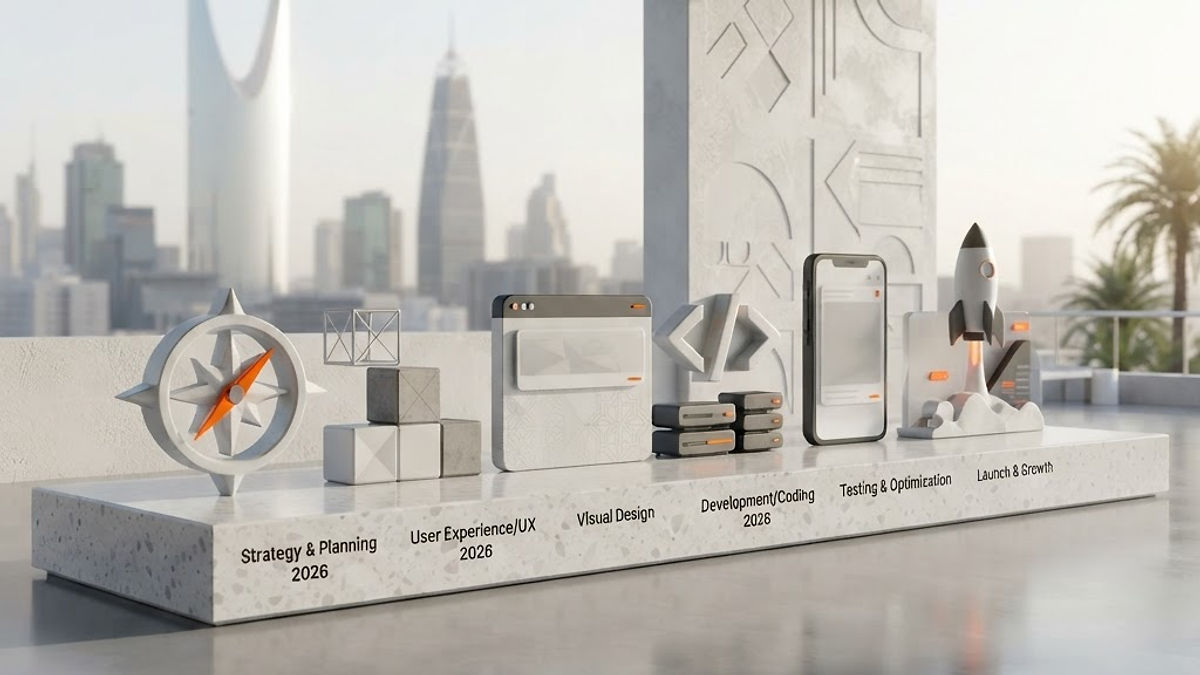
Many business owners in Riyadh, Jeddah, and Dammam search for clear website design steps that help them launch a successful website for their company without wasting time or budget on poorly planned experiments. As we move into 2026 and the Saudi digital market continues to grow, a website is no longer a luxury — it has become an essential interface representing your brand to customers around the clock. In this article, we walk you through a practical and logical path, starting from planning and requirements analysis, moving through design and development stages, and ending with launch and continuous optimization, while clarifying the key requirements for building a successful business website, what affects the cost of creating a website, and how to choose a web development company that fits your project's needs.
Why Your Company Needs a Clear Plan Before Starting Design
Digital competition in major Saudi cities has increased noticeably, and customers now search for services through search engines and social media before making a purchase decision. A website is often the first touchpoint with a large number of potential customers, so the absence of a clear plan can lead to wasted time and budget on repeated adjustments after launch.
Following well-thought-out website design steps from the start helps you avoid rebuilding from scratch, and ensures the website aligns with your marketing and operational goals, whether your goal is to showcase your services, sell products through an online store, or generate inquiries from potential customers. Good planning also makes communication with a web development company easier and reduces the chances of misunderstanding the technical scope of the project.
For example, the owner of a furniture showroom in Dammam may need a website that displays a product catalog with high-quality images and allows visitors to request a showroom visit, while a medical clinic in Riyadh needs a website focused on online booking and doctor profiles. The difference in goals between these two examples shows why there is no one-size-fits-all template, and why every step of website design must be built on a precise understanding of the nature of the business.
Stage One: Planning and Requirements Analysis
This step is the cornerstone of any successful project, and includes accurately defining the requirements for building a business website before thinking about design or development. At this stage, your company needs to answer fundamental questions that determine the entire course of the project.
- What is the main goal of the website: an introductory showcase, an online store, or a services platform?
- Who is your target audience and what is their browsing and purchasing behavior?
- What is the approximate available budget and the expected launch timeline?
- Do you need two languages (Arabic and English) or special features such as booking or online payment?
- Who will manage the content after launch?
Answering these questions gives you a clear requirements document that later makes it easier to compare offers between development companies, and ensures that the technical team builds the website according to your actual needs rather than general assumptions.
Examples of Defining Goals by Business Type
The requirements for building a business website vary depending on the nature of the business, and it is useful to identify your type from the following list before moving to any subsequent stage:
- Service companies: need clear service pages, contact forms, and possibly online appointment booking.
- Online stores: need a product catalog, shopping cart, and reliable local payment gateways.
- Clinics and medical centers: need a booking system, pages introducing the medical staff, and patient data privacy.
- Real estate companies: need to display projects with high-quality photos and videos, and possibly virtual tours of the projects.
If your business is in the real estate sector, for example, adding professional visual content raises the credibility of the website, and you can review the details of this type of solution in Virtual Tours for Real Estate: The Secret to Accelerating Your Sales in Saudi Arabia 2026 to understand how to integrate this service into your website in a comprehensive way.

Stage Two: Choosing a Web Development Company Suited to Your Project
After defining requirements, the next step is choosing a reliable technical partner. Choosing a web development company that matches the size and nature of your project saves you a lot of effort later, as the difference between a simple introductory website and a full-fledged online store requires different expertise in development and design.
When evaluating companies, it is useful to review their previous work in the Saudi market, and to see how they have dealt with clients from sectors similar to yours. You can benefit from reading specialized content such as Website Development in Saudi Arabia: Digital Solutions for Growing Your Business 2026 to learn more about the criteria for choosing the right development partner.
Questions to Ask Web Development Companies Before Signing a Contract
To avoid surprises during implementation, it is useful to ask any company you are considering working with the following questions:
- What is the expected implementation timeline for a project the size of mine?
- Is the design fully custom or based on ready-made templates?
- Who owns the source code and content rights after delivery?
- What is the technical support and maintenance policy after launch?
- Does the service include hosting and email setup for the domain?
It is also important to ask about the support mechanism after launch, and whether the service includes hosting and maintenance, or is limited to delivery only. Clarity on these points from the beginning reduces surprises later and protects your investment in the website in the long run, especially since some websites need periodic updates classified under what is known as software maintenance, which ensures the website continues to function efficiently over time.
Stage Three: Designing the User Experience and Visual Identity
After agreeing with the technical team, work begins on designing the website's interfaces. This stage combines the aesthetic and functional aspects, as it is not enough for the website to be visually attractive — it must also be easy to navigate and guide the visitor toward taking a clear action such as contacting you or making a purchase.
User experience (UX) plays a major role in keeping visitors on the website and building their trust in the brand, which is why it is considered one of the most important steps in designing a successful website. You can find broader details on this aspect in the article The Importance of User Experience in Search Engine Rankings.
The website design should also consistently reflect your visual identity, from colors to fonts and the logo, because any conflict between the brand identity and the website weakens the visitor's trust in the company's credibility. This stage requires careful coordination between the design team and the project owner before moving to actual development, especially when dealing with Arabic, which requires a right-to-left (RTL) writing direction and clear fonts that support fast reading on mobile devices.
One of the practical points that some overlook when designing professional websites in Saudi Arabia is taking into account local user preferences, such as making contact numbers clear and linking them directly to WhatsApp, displaying the address accurately on Google Maps, and adding real photos instead of stock images whenever possible to enhance trust.
Stage Four: Development and Technical Build
After the designs are approved, the development team begins turning them into an actual website that runs smoothly across different devices, especially mobile, given the high rate of mobile browsing in the Saudi market. This stage includes choosing a content management system or custom build, connecting databases, and preparing the website's core pages.
In general, there are two main development paths you can choose between depending on the nature of your project:
| Path | When It's Used | Practical Notes |
|---|---|---|
| Ready-made content management systems | Introductory websites and medium-sized stores | Faster launch, relatively lower initial cost |
| Fully custom build | Complex platforms or those with unique features | Greater flexibility in the long run, but requires more time and budget |
If your project includes selling products, this step requires integration with local payment gateways and inventory management systems, and you can review the details of this type of project in E-commerce Development in Saudi Arabia: Professional Solutions to Increase Your Sales.
Don't forget the hosting and email aspect linked to your company's domain, as it is one of the basic requirements for building a business website that some overlook. You can review how to handle this in Hosting Services and Email Setup. Choosing the right hosting directly affects the website's speed and security, which is a factor search engines consider when ranking search results for users in the Kingdom.
Stage Five: Content Writing and Search Engine Optimization
A technically beautiful website alone is not enough to attract customers; content is what convinces the visitor to stay and engage. At this stage, the content of each page is written in clear language that speaks to your Saudi audience, highlighting your services and strengths without exaggeration.
Search engine optimization (SEO) is an integral part of successful website design steps, because it determines how visible your website is when customers search for your services on Google. This includes selecting appropriate keywords, structuring links, and page loading speed. To expand further on this aspect, you can review Improving Your Visibility on Search Engines (SEO).
It is also useful to plan for future marketing content such as a blog or FAQ pages, as they boost search engines' trust in your website over time, and increase the chances of reaching new customers organically without relying entirely on paid advertising. It is also recommended to add professional photos and videos that reflect the nature of your work, whether photos of your products or your team, as visual content increases visitor trust and time spent on the page.
Stage Six: Testing, Launch, and Follow-up
Before officially announcing the website launch, you must go through a comprehensive testing phase to ensure all links and forms work correctly, and confirm the website is compatible with various browsers and devices. This step protects your company's reputation from any technical errors appearing in front of customers right after launch.
Practically, you can follow this order when launching:
- Test the website's speed on mobile and desktop.
- Make sure contact forms and payment gateways (if any) work.
- Review the content linguistically and confirm it is free of errors.
- Connect the website to analytics tools to track visitors after launch.
- Announce the launch through the company's communication channels.
After launch, the follow-up and continuous improvement phase begins based on actual visitor behavior, a step that is often neglected despite its importance in maintaining the website's performance in the long run. It is also a good idea to review the website's performance at least a month after launch, to find out the most visited pages, the most common exit points, and use this data to gradually improve the user experience instead of simply launching and leaving it unmonitored.
Cost of Creating a Website in Saudi Arabia: What Determines the Price?
The cost of creating a website varies greatly depending on the type of website and the level of customization required, and there is no fixed number that applies to all projects. The following table shows the main factors affecting cost in general:
| Website Type | Appropriate Use | Factors Affecting Cost |
|---|---|---|
| Simple introductory website | Displaying services and contact information | Number of pages, custom design |
| Medium-sized company website | Showcasing multiple services with a blog | Multiple languages, content, analytics integration |
| Online store | Selling products directly to customers | Payment gateways, inventory management, security |
| Advanced services platform | Booking or managing customer requests | Custom development, control panels, integration with other systems |
For broader details on this topic, you can read The Cost of Website Design in Saudi Arabia: Your Comprehensive Guide, a good reference for understanding how to build a realistic budget for your project before requesting quotes from development companies.
In addition to the initial design and development cost, it's important to set an approximate annual budget for domain and hosting renewal, as well as any periodic content updates or technical maintenance, because overlooking these ongoing costs may cause the website to stop working or lose its appeal over time without the project owner noticing early enough.
Common Mistakes to Avoid When Designing Professional Websites in Saudi Arabia
Some companies fall into recurring mistakes that affect the success of the website despite seemingly following sound website design steps. The most notable of these mistakes include:
- Starting the design before clearly defining goals and the target audience.
- Neglecting the mobile user experience despite the high percentage of mobile browsing.
- Choosing a web development company based on price alone without considering quality and technical support.
- Ignoring search engine optimization from the start and then trying to fix it later.
- Not allocating a budget or plan for content updates after launch.
- Neglecting to link the website's visual identity to the rest of the company's marketing materials, creating confusion in the customer's mind.
Avoiding these mistakes from the planning stage saves a lot of time and cost later, and makes the experience of building the website closer to a long-term investment rather than just a technical expense. In this context, it's useful to review Visual Identity to understand how to properly link your company's identity with its website design in a comprehensive way.
Additional Practical Tips for a Successful Website Project
Beyond the basic stages, there are a number of practices that help raise the quality of the final website experience, especially in the competitive digital environment of major Saudi cities:
- Make sure the contact button (WhatsApp or direct call) is visible on all pages of the website, not just the contact page.
- Use realistic photos and videos instead of stock content whenever possible to enhance credibility.
- Keep the quote request or contact form short and easy, as long forms reduce engagement rates.
- Review the website's loading speed periodically, especially after adding new content or large images.
- Plan to update the website design periodically to keep up with evolving user visual expectations.
These small details may seem secondary, but they often make the difference between a website that achieves its business goals and one that remains merely a formal front without any real impact on business growth.
Frequently Asked Questions About Website Design in Saudi Arabia
How long do website design steps take from start to launch?
The duration varies depending on the size and complexity of the website. Simple introductory websites take less time than online stores or platforms with advanced features. Advance planning and precisely defining requirements helps speed up subsequent stages, while delays in approving content or designs are among the common reasons for extending the timeline.
What is the difference between an introductory website and an online store?
An introductory website focuses on displaying the company's services and information without direct sales operations, while an online store includes displaying products and linking them to payment methods and inventory management, making it more technically complex and requiring additional testing before launch.
Should the website be in both Arabic and English?
This depends on the nature of your target audience. If your company deals with English-speaking customers or foreign investors, supporting both languages may be useful. If your audience is primarily local, you might start with Arabic only in the first phase and add a second language later as the business grows.
How do I choose a web development company suitable for my project?
Review the company's previous work, ask about its experience in your field, and make sure the scope of work and technical support after launch are clear, rather than relying on price alone as a selection criterion. It's also useful to ask for examples of previous websites that are actually running, so you can confirm the quality of execution in practice.
What factors increase the cost of creating a website?
The number of pages, custom design, payment gateway integration, multiple languages, and advanced technical features such as control panels or integration with external systems are all factors that affect the final project cost, in addition to ongoing hosting and maintenance costs after launch.
Conclusion
Following clear and organized website design steps is the difference between a website that actually serves your company's goals and one that remains a technical burden requiring constant adjustment. From planning and requirements analysis, through choosing a reliable web development company, to launch and follow-up, each stage deserves enough time and focus to achieve results worthy of your brand in the Saudi market.
If you are planning to launch or develop your company's website during 2026, the VENETS AGENCY team would be happy to help you build a professional website that fits your goals and budget. Request a Quote Now and take your first step toward a stronger digital presence for your company.